
The Cost of Reactive Quality:
Why Sourcing and Operations Own the Risk That Quality Didn’t See
Most shortages and supplier issues don’t arrive without warning. The risk signals that precede them often sit inside a quality system, unused by sourcing and operations teams. Oversight failures are shared. So is the cost.
~80%
of sites show measurable risk signal drift within 12 months of an audit.
Qualifyze analysis.
75%
of CAPA submissions are overdue at point of follow-up.
Industry analysis.
24–36 months
typical audit interval. The window where supplier risk evolves unseen.
Industry standard audit cycle range.
+55%
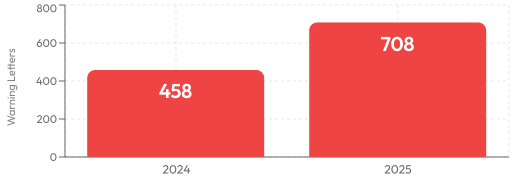
increase in FDA Warning Letters issued in 2025 vs. 2024.
FDA data
THE PROCUREMENT BLIND SPOT
You qualified the supplier. You signed the contract. You still own the commercial risk.
When a supplier fails, sourcing absorbs the operational cost, the continuity risk, and an increasing share of the regulatory scrutiny. But sourcing teams’ visibility into supplier quality is built on lagging indicators, defect rates that move after the fact, recall notifications that arrive too late, and audit reports that describe a point in time that has already passed.
Supplier events threaten continuity
If a primary supplier fails qualification, the industry standard to qualify an alternate is 18 to 24 months, representing prolonged revenue exposure that no procurement team can absorb without consequence. Based on the Gartner® report Quantify Supplier Disruption to Align Risk Appetite and Costs, supplier risk disruptions can increase Total Cost of Ownership (TCO) by up to 40% per incident, with annual disruption costs ranging from $228 million to $1.3 billion, depending on the industry.
TCO Increase
40%
per incident
Qualification Time
18-24
months
Annual Disruption Costs
$228M – $1.3B
depending on industry
Gartner® — Quantify Supplier Disruption to Align Risk Appetite and Costs (G00843343)
Disruptions noticeably hit the bottom line
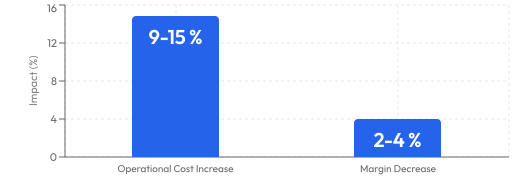
Based on the Gartner® Table 1: Cost of Disruption and Mitigation by Industry from the report Quantify Supplier Disruption to Align Risk Appetite and Costs, disruptions in pharma and high-tech drive a 9% to 15% increase in operational costs and a 2% to 4% decrease in margins.
Gartner® — Quantify Supplier Disruption to Align Risk Appetite and Costs (G00843343)
Regulators are clamping down
FDA Warning Letters surged 54.6% in 2025, 708 letters vs. 458 in 2024. When your supplier is cited, your supply chain is in the public record. The reputational damage and business continuity impact go well beyond the quality team.
FDA data
Supplier issues are getting worse
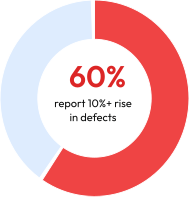
Failures by third-party suppliers are explicitly categorised as one of the major causes of supply chain disruptions, alongside cyberattacks and extreme weather. According to the Gartner® report Improve Supplier Quality Governance, Performance and Talent, 60% of organizations report at least a 10% rise in the number of issues due to supplier quality defects. Unlike weather events or cyberattacks, supplier deterioration is measurable in advance through quality signals.
Gartner® — Improve Supplier Quality Governance, Performance and Talent (G00792324)
The indicators sourcing and operations relies on change when the disruption is already happening. The intervention window has already closed.
THE SIGNAL TRAIL
Signals that precede supplier failures are measurable. Many of them sit in quality systems.
When supplier data is analysed retrospectively, looking at the 12 months before a Warning Letter, a consistent pattern appears. Risk accumulates across signals long before any single event demands attention. The problem is not detection. It is that sourcing and operational teams have no direct access to these signals, and Quality teams tend to over-rely on point-in-time audits.
The audit trail isn't silent
57%
of sites that later receive a Warning Letter carry Major or Critical observations on record at their most recent audit.
Overdue CAPAs precede enforcement
65%
of sites that subsequently received a Warning Letter, had an overdue CAPA on record.
By the time the buyer sees it, the signal is old
15 months
is the average time since their last customer audit for sites that received a Warning Letter.
Qualifyze analysis.
The signals exist. They are already being generated. They are simply not being read, by quality and procurement, together, in real time.
THE OVERSIGHT GAP
Two oversight cycles. The same blind spot.
Your quality team audits on a 24–36 month rotation. Your sourcing review runs on commercial performance, usually annually. Neither cycle is built to read real-time quality drift, so the risk doesn’t arrive at your next touchpoint. It accumulates in the gap between them, unseen by either function.
Your last audit
point-in-time snapshot
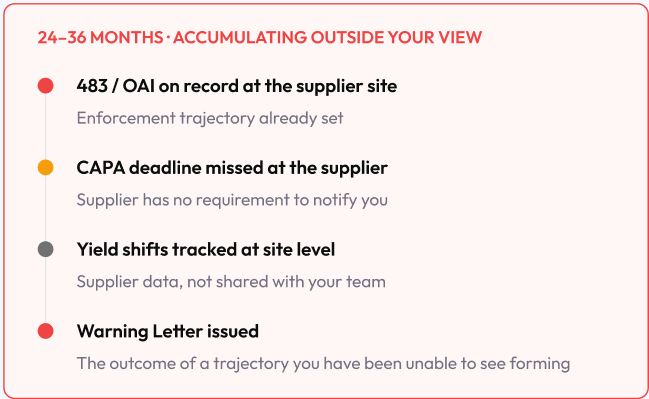
Your next audit
first real touchpoint since the start
4+
signals on record at the supplier site
0
visible to your quality or sourcing team
Regulatory signals don't wait for your review cycle
An OAI can sit on the supplier’s record for months before it surfaces in your next quality review. By the time it does, the enforcement trajectory is already underway. The Warning Letter is the outcome, not the signal your team needed to act on.
CAPA deadlines pass without reaching your team
A CAPA deadline can pass on the supplier side with no regulatory requirement for the supplier to notify your quality team. From your perspective, it was on track the last time anyone looked. Without continuous monitoring, a missed deadline won’t surface until your next scheduled review.
Operational data stays at the site, not in your view
Batch rejection rates and yield shifts are tracked by the supplier at site level but rarely shared with your quality team between audits. Under a periodic review model, the data exists and is simply not reaching you.
Two formal touchpoints. Everything in between compounds
Everything in between compounds at the supplier site, outside your view. The blind spot isn’t a single missed event, it’s the entire window where signals are accumulating and neither your quality team nor your sourcing team is positioned to read them.
17
According to Gartner®, “Organizations experience an average of 17 unfamiliar, high-impact disruptions per year . Without the benefit of real-time analytics or automated risk analysis, significantly heightens the risk of mismanagement, delayed responses, and substantial financial losses.”
Gartner® — Predicts 2026: Realizing the Supply Chain AI Opportunity (G00845304), citing the 2024 Gartner® Future of Supply Chain Survey
“A site’s risk profile rarely changes overnight. It changes between audits, in CAPAs that drift past their deadlines, in observations that escalate from minor to major, in regulatory actions that arrive months before anyone notices. The signals are always there. The question is whether you’re reading them.”
Martin Lehmann · Chief Product Officer · Qualifyze
THE SHARED OVERSIGHT MODEL
What changes when quality, sourcing and operations consistently read the same signals.
The shift to continuous supplier oversight is not a program rebuild. It is a reprioritisation, directing existing Quality and Operations resources toward the sites where the signals are actually drifting, and enabling better collaboration through a common data foundation and risk management signals.
| Dimension | Reactive / Periodic | Continuous / Shared |
|---|---|---|
| Risk visibility | Point-in-time audit snapshots |
Continuous site risk scoring, updated daily across the full supplier base
|
| Audit prioritisation | Calendar-driven schedule |
Signal-driven, resources directed where risk is drifting
|
| Regulatory monitoring | Certificates and inspection outcomes tracked manually, case by case. |
Automated daily feeds, warning letters and inspection outcomes tracked per site in real time
|
| CAPA tracking | Status reviewed at fixed intervals, drift undetected |
Adequacy and closure tracked automatically and continuously.
|
| Procurement visibility | Commercial performance review; quality data reviewed separately at audit |
Shared view, quality signal trajectory visible before contract renewal
|
| Regulatory posture | Audit-based documentation of oversight |
Documented continuous risk assessment suited for regulatory response
|
THE ECONOMICS OF OVERSIGHT
You are already paying for supplier disruptions. The question is whether you can see it.
A continuous oversight model is not justified by the cost of audits avoided. It is justified by the cost of disruption already absorbed, paid quietly, in operational overhead and margin compression, in line items that rarely carry the word “disruption” on them.
Annual cost of supplier disruption, pharma
$1.278 billion
This is what supplier disruption events add up to across the pharma sector each year. The per-disruption hit (9–15% on operational costs, 2–4% off margin) compounds quietly across organisations that are absorbing it without a clear view of what’s driving it.
Gartner® — Quantify Supplier Disruption to Align Risk Appetite and Costs (G00843343)
The cost is known. The signals that precede it are not acted upon.
The previous figures quantify what the industry absorbs. The Qualifyze data shows what precedes it, in CAPA behavior, in observation trends, in regulatory activity that arrives months before anyone on the buyer side notices.
The Supplier Base Risk Check gives quality and procurement a shared starting point: a first assessment of where those signals stand across your supplier base today.
Gartner® is a trademark of Gartner®, Inc. and/or its affiliates.

Request Your Supplier Base Risk Check
We map your supplier portfolio against the signal patterns explored in this research, and show you where the indicators are pointing today, for both quality and procurement.

You submit the form
A few details about you. One minute to complete.

You receive the analysis on a 30-minute call
One of our specialists walks you through the findings live, where the signals stand across your supplier base today, for both quality and procurement.